Happy Bird Place

Click on the picture to go to my website.
Thursday, September 30, 2010
Probably pastel, not blue gouldian baby
I went through my gouldian genetic forecaster, and based on the parent's genetics, the gouldian baby should be pastel, not blue. One step closer.


Wednesday, September 29, 2010
More babies - perhaps first blue gouldian??

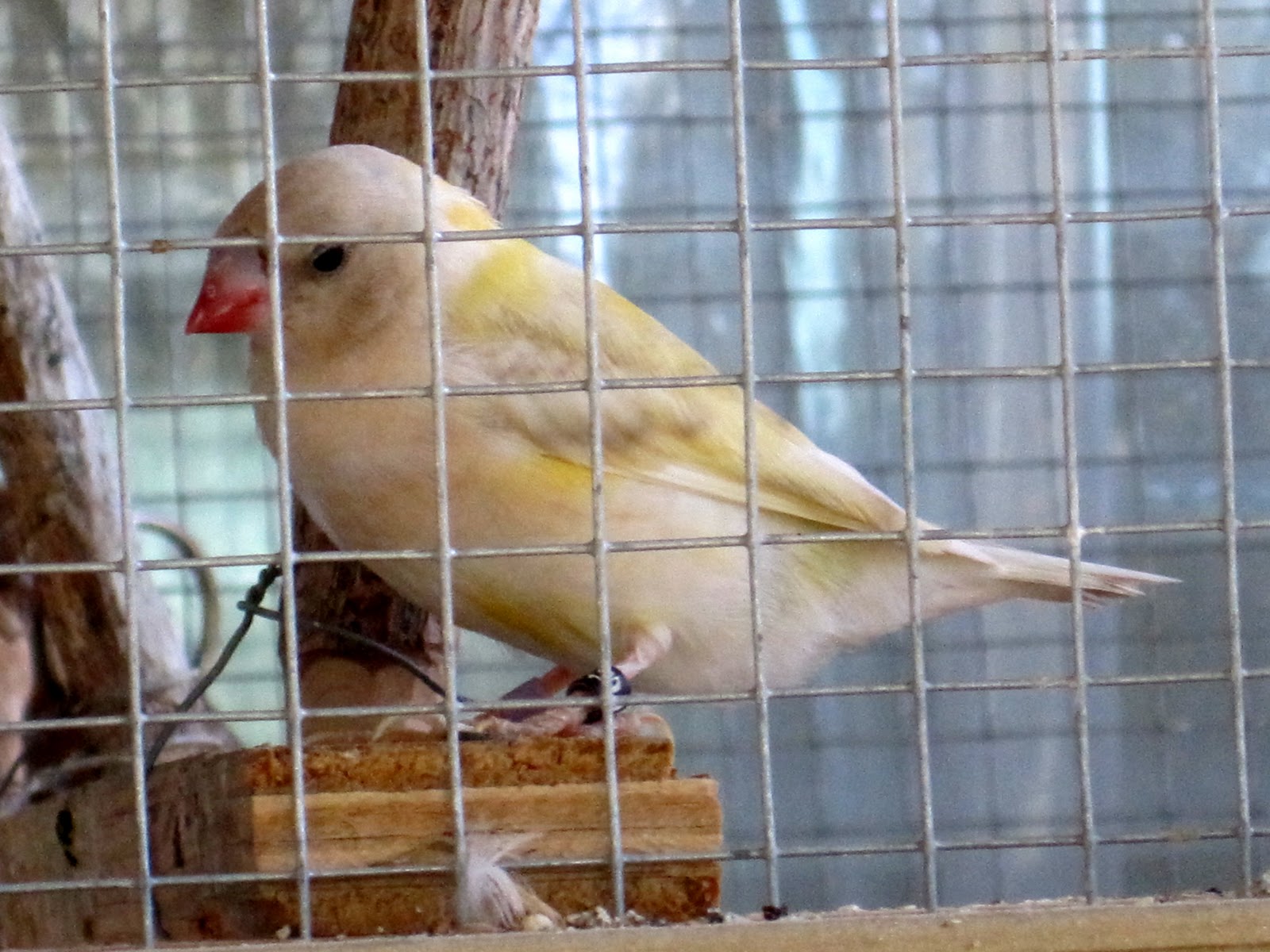

As for the linnies, Captain Turq and Cream Puff's eggs were all DIS or infertile. Not sure if there really is a genetic issue or they stop sitting well toward the latter part of incubation, but they have restarted laying eggs already. Frustration! All these fertile eggs but always DIS. Indy and Blondie are still completely ignoring their nest box and are shredding newspaper and playing under their newspaper "tent". Silly linnies.
The 2 society fostered gouldian babies are growing well - I have already been able to close band them - both looking like they will be yellow. Their parents laid again with 4 fertile eggs, but tossed and killed the 1st hatched baby, so I had to also foster out their 2nd clutch. Two of the remaining 3 eggs hatched - 1 yellow and 1 normal vs dilute. The last egg was DIS. I don't think the hen was the tosser as she did fairly well last season. Her new mate is 2 years old but this is his first time breeding, so perhaps he is just inexperienced. I will allow them to try for a 3rd clutch before separating them since they've yet to do any hard work.
Shaft tails are finally investigating nests. The nests put into the large flight have also been met with great interest by the shaft tails and red headed parrot finch pairs. We shall see if any babies result from all this enthusiasm.
Trying to make sure all the parents have enough high protein soft food can be expensive. I have tried to give fresh egg food, but the constant concern for spoilage have led to using dried soft food/egg food only. I've been using Miracle Meal so far, but have decided to try out Higgins Proteen 25 and Petamine to see if I can save on cost. I am still providing chitted seeds everyday. Mealworms and dried bloodworms are added as well. Veggie salad is provided daily. Different supplements are provided in the water as well. I've started to try Nekton E and Nekton S in additional to my previous regimen. Hopefully everyone will take to the new products without problems.
Monday, September 27, 2010
Splendid baby pictures
Red and Scarlet's babies are growing fast. Everyone is getting fed and growing well now. Just banded the 2 oldest babies today. Eyes are starting to open and pin feathers are coming through. Coral and Blushe's 4 fertile eggs are hatching anytime now. I saw the oldest egg starting to crack, so am expecting the 1st baby to hatch tonight.
 Here's a group shot - should be 4 babies, but 1 is hidden.
 See the size difference between 1 of the older babies and the youngest (face down on the left).
 Here's the oldest baby whose eyes are already open.
 Oldest baby - leg band #17.
 Second oldest - leg band #18.
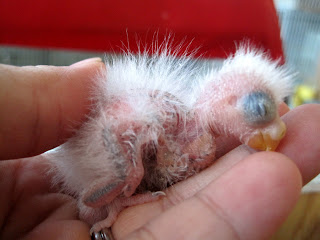 The youngest baby, a bit too young for leg band still.
It's really not that hard to band babies with closed bands with some practice. Usually age 9-10 days are the best days. I find when pin feathers are just starting to come through correlates well with when banding should be down - see above older baby pictures. All 3 of the longest toes should be put through the closed band ring all at once, then the ring should be slid over the 4th back toe. Beware of the toe nail of the 4th toe catching. The band should not be able to be slit back out over all 4 toes or it may fall off. Some people use some mineral oil to help with the process. I've never found it to be necessary when done on the right size/age chick.


It's really not that hard to band babies with closed bands with some practice. Usually age 9-10 days are the best days. I find when pin feathers are just starting to come through correlates well with when banding should be down - see above older baby pictures. All 3 of the longest toes should be put through the closed band ring all at once, then the ring should be slid over the 4th back toe. Beware of the toe nail of the 4th toe catching. The band should not be able to be slit back out over all 4 toes or it may fall off. Some people use some mineral oil to help with the process. I've never found it to be necessary when done on the right size/age chick.
Wednesday, September 22, 2010
8 afterall...
Unfortunately, one of the older scarlet chested chicks died, so now there are just 4 babies that have hatched from Red and Scarlet. I am unsure of what happened since the chick had food in it's crop. Today another chick had an empty crop and was shivering. Perhaps there is an infection going through. I handfed the babies with some antibiotics and handfeeding formula. Hopefully whatever is going around will be stopped without further losses. Blush is sitting tight on her 4 fertile eggs.
The 2 gouldian babies fostered to societies are doing great and growing fast. I've put together a few new pairs of gouldians to replace the pairs that have just been staring at each other without much happening. The parents of the fostered babies have 4 more fertile eggs in the nest, and my best pair from last year have 5 fertile eggs. Interestingly, one of my best BH pairs from the past 2 years seem reluctant to breed this year - perhaps the hen is just not ready yet. I'll probably put them back into the flight cages for a few more weeks then try again.
The shaft tails are more interested in sitting on top of the nest than doing anything in it. They are all young birds just getting to be about 1 year old - perhaps that is the reason for no interest in breeding? I did put up some nests in the big flight cage where the purple grenadiers and some of the RH parrot finches and yellow faced stars and a couple pairs of the shaft tails are. Everyone seem to be somewhat interested in the nests. We shall see if anyone actually does something more productive than roosting in the nests.
The mealworms have arrived, so the waxbills will be slowly re-introduced to some live food for their breeding season. So far, the keets and gouldians have been as interested in eating them as everyone else. Perhaps I should have ordered more...
The 2 gouldian babies fostered to societies are doing great and growing fast. I've put together a few new pairs of gouldians to replace the pairs that have just been staring at each other without much happening. The parents of the fostered babies have 4 more fertile eggs in the nest, and my best pair from last year have 5 fertile eggs. Interestingly, one of my best BH pairs from the past 2 years seem reluctant to breed this year - perhaps the hen is just not ready yet. I'll probably put them back into the flight cages for a few more weeks then try again.
The shaft tails are more interested in sitting on top of the nest than doing anything in it. They are all young birds just getting to be about 1 year old - perhaps that is the reason for no interest in breeding? I did put up some nests in the big flight cage where the purple grenadiers and some of the RH parrot finches and yellow faced stars and a couple pairs of the shaft tails are. Everyone seem to be somewhat interested in the nests. We shall see if anyone actually does something more productive than roosting in the nests.
The mealworms have arrived, so the waxbills will be slowly re-introduced to some live food for their breeding season. So far, the keets and gouldians have been as interested in eating them as everyone else. Perhaps I should have ordered more...
Sunday, September 19, 2010
Few more pictures...


Saturday, September 18, 2010
I mean 9...my bad, and more pictures...
Blush came out of her nest box this morning, and I see 4 live eggs! Not sure if I was hallucinating the first or second time, but I'm thinking 9 total scarlet chest babies this round. Red and Scarlet have 3 hatched babies with 2 more yet to hatch as of today.
 Red, one of my gorgeous normal scarlet chested grasskeet males. I interrupted his veggie snack - see some still on his beak. His busy eating and feeding Scarlet so she can feed the 3 newly hatched babies. Behind Red are some of my gouldians who are not breeding yet.
 As promised, here are some pictures of my new scarlet chest mutations - here is Blue, the young white chested blue splendid grasskeet male. He is still molting into his adult feathers, but already getting his white chest, which is usually red on a normal splendid/scarlet chest. He should be split for ino.
 Here is Snow White, the albino splendid hen. She is the most vocal splendid hen I've ever seen, singing as well as the boys. So well, in fact, I had to ask her breeder to make sure she is a she, not a he. She is DNA sexed to be a hen. The albino is the white chested blue combined with the lutino gene.
 Ruffus the rubino bourke male along with the new splendids. I am still awaiting a rubino hen who will be his mate.
 Here he is again. He doesn't have his full tail feathers as he is molting.
 Here is Rose, my rosey bourke hen on the left, with Apollo, my yellow turquoisine male who is red-bellied and molted into a bit of a red necklace this year as well.
 Sunnie is the new mate for Apollo and is a red-bellied yellow turquoisine hen. She is replacing Sunny, my poor yellow turquoisine hen who didn't make it after several weeks of fighting off one infection after another. She is still quite young and doesn't have all her adult colorings yet. My male yellow faced star finch is to the left.
 The new zebra babies - 4 out of 6 survived, 3 CFWs and 1 normal gray. Here are 2 of them.


One of my creamino shaft tails - this is the male. I absolutely love their coloring. Sadly, no one is in the breeding mood yet, but they are young birds.
 From left to right, a yellow headed white breasted yellow split to blue male gouldian, a normal shaft tail hen, and Turkey, my normal split to yellow turquoisine male.
 Here's the yellow headed white breasted single factor yellow split to blue male gouldian again - he gets a second shot since he was the only one cooperative enough for a close-up ;D.
 A straw-headed (either red head or orange head) purple breasted blue backed male gouldian in the foreground with a few gouldian hens in the background.
 First 2 gouldian babies of the season! While it's unfortunate I had to foster them under my helpful societies, I'm still glad they are here. Looks to be 2 yellow babies - see the 2 little head under the breast of their foster father, a pied fawn society.
 Here he is feeding one of them.


One of my creamino shaft tails - this is the male. I absolutely love their coloring. Sadly, no one is in the breeding mood yet, but they are young birds.


Thursday, September 16, 2010
Actually 8
Red and Scarlet's second baby is hatched. Three more to go!
 Here's the whole brood.
 Baby number 1 is a little bit bigger already with food in its crop.
 Here's the 2nd baby with it's sibling on it's side and the 3 more fertile eggs yet to hatch.
 Coral and Blush, on closer inspection actually only has 3 fertile eggs. The 4th is clear so far, not sure if it requires more days of incubation or is simply infertile. Here's an egg at an earlier stage of development - the red round area is where the beating heart can be seen.
 Here's a praying mantis who came to visit. Love the little guys/or gals despite their ferociously lethal nature.


Subscribe to:
Posts (Atom)